Language is the vehicle of our expressions. Sanskrit is the most ancient language enriched with high inflectional and structurised grammar, flawless, accepted by the linguists. One of the Sanskrit writers, the great 'dandi' proclaims -'all these three worlds would have been in complete dark, had it been not lit up these by the light of speech (इदमन्धतमः कृत्स्नं जायेत भुवनत्रयम् ।
Tuesday, March 24, 2009
sanskrit manuscripts


Wednesday, June 11, 2008
PhD opportunity at IIIT-H
There is an exciting opportunity at IIIT Hyderabad to do PhD in Centre for Exact Humanities.
Follow this link - http://iiit.ac.in/PhD_Announcement.html
Regards
Tuesday, January 16, 2007
How ancient is Hinduism?
Once any human being has took birth in any so called 'religion' on this earth, that can not be changed until his death. The Sindhu civilization has nothing to do withthe term 'Hindu.' These all are created historical facts (fallacies). Starting from the Vedic period to the recent Kavya literature, one's effort in searching the term 'Hindu/Hinduism' will go in vain. So many invasions spoiled our culture and degraded the Indianness, that even become worse during the British empire. Along with them, the British has brought 'religion' and influenced the ancient Indian culture a lot. So, if one needs to know more about the 'sanatana dharma,' sankara mathas like sringeri etc.. are only for the refuge.
Monday, January 08, 2007
National workshop on Vaiseshika Formal Ontology
There will be a workshop on 'Vaiseshika Formal Ontology' at University of Hyderabad from 2nd April-7th April, 2007. The information is hosted on University's website. People from NLP, Philosophy, Cognitive Science, Mathematics and CS are eligible to participate. The last date to apply is 28th February'07. Objectives of the workshop are-
To present formal ontology based on Vaiseshika.
To formally derive exhaustive system of the categories of reality.
To articulate laws of causation, action and change within category system.
To give mechanics of cognitive processes.
To derive jural, social, historical and cultural objects.
You can get the information at http://ltrc.iiit.net/flyer-wkshp-07.pdf
Tuesday, October 31, 2006
Much Ado about Nothing
Interestingly, Sanskrit has contributed to most of the Indian lanuguages and especially to Telugu. 60% of its vocabulary borrowed from the mother Sanskrit. Taking from the Sri Madandhra Mahabharatam to the present day news papers, Sanskrit is an inseparable part of the lanuguage.
Since most of the students join in corporate colleges, studied in English medium they don't have any Telugu flavour in their school education. Naturally they go for Sanskrit instead of Telugu/French because they have a chance to write exam in English. Just by studying Sanskrit for two years at Intermediate level, no damage is seen to Telugu in reality. Let the parents talk in Telugu to their children. Let the Telugu TV channels use pure Telugu language or from primary education itself teach Telugu and Sanskrit compulsarily for 100 marks.
There are numerous ways to solve this issue, but not by banning Sanskrit language from curriculum.
information
This is for your kind information.
Tuesday, October 24, 2006
Ayurveda referred..

'Langhanam paramaushadham' is a well known saying in Ayurveda,
probably told by the 'Charaka.' When you are suffering with fever,
we used to be advised by grandma to fast for a few hours or days.
In India, for centuries together, this is a natural practice.
But the modern medicine has ignored this practice for a long time.
Interestingly, the modern medicine is adapting this practice to
cure diseases like, Gastro-Intestinal, Metabolic, Skin related etc.,
according to a news paper. A clinic in Germany, 'Buchinger's
Clinic'(Bad Pyrmont) adapted this technique called 'Buchinger Fasting Cure.'
Buchinger prescribes a low calaried food up to 300 calaries per day
alongside Naturopathy. They have proved that this fasting cure is
very effective in Migrane, Diabetes, Rheumatism, Psoriasis etc.
In Scandinavia also, the same method is proved in curing Artheritis.
Monday, October 23, 2006
End of Sanskrit era at Cambridge
Cambridge has few hundreds of Sanskrit palm leaf manucscripts in its library. Since lack of funds is the cause to the closure of the dept., honestly Cambridge should get back these manuscripts to India where a National Manuscripts Misson is set up by the Indian Government for its preservation. The Oxford Uniiversity has a Sanskrit chair as old as Cambridge's and Edinburgh University also has a Sanskrit dept. We've to see some amount of reaction from these institutions.
I quote hear some interesting remarks on this issue from a forwarded mail-
"it is a natural closure for sanskrit in cambridge since sanskrit
studies in cambridge were started only courage the british scholars to
despirit indians in the colonial context which no more needs any
attention. there is no need to mourn it. is should be celebrated instead. Sanskrit survived three millineums
without cambridge and will survive three more.
Vice chancellor of cambridge! Thanks, advise the same to oxford.
this news could not have come on a more appropriat date on which same
paper announces that IITs are in third place ahead of all the british
Engineering universities."
Tuesday, July 25, 2006
Ayurveda in Delhi University
Delhi University has introduced the 'Ayurveda' subject in in its Sanskrit paper for 30 marks. This very paper consists of Jyautisha, Yoga also. I cordially congratulate the committee for redesigning the Sanskrit paper. This gesture motivates the students to take higer studies in these traditional sciences research.
This news is one week old!
Monday, July 24, 2006
Sadhana Grantha Mandali
I want to let you Sanskritists to know about a Sanskrit publisher in Andhra Pradesh. Its called 'Sadhana Grantha Mandali' located in Tenali, Guntur district. A Sanskrit scholar Brahmasri 'Bulusu Surya Prakasa Shastry' has started this Mandali in 1950s, while working as a Sanskrit teacher in the Govt. school in Tenali. But he hails from the costal area of Andhra from where a number of Vedic, Sanskrit scholars were born.
Since its inception, this Mandali is doing yeomen service to the Sanskrit knowing Telugu community by way of publishing all the Shankara Bhagavatpada's works translated in Telugu. They have published almost all of the Stotras of Sri Sankara and many upanishadic works are being translated now. The aim of the Mandali is to publish all of the Sankara's works.

This centenarian, sri Shastriji, tirelessly working for a noble cause for the many decades has carefully replies and acknowledges the queries, requests and himself pack the books to be sent through post. His patience even in his 100s is amazing!! In March 2006 I have visited his house(0ffice) to purchase some books and also found the same enthusiasm and zeal like he might be in his fifties. He has enquired about the benefits of computerizing the Traditional knowledge and information retrieval facilities not so much impressed.
Accompanied by his third son, he has a big list of books to be published seeking contributions/donations from the philonthropists, Sanskrit lovers. His dedication and hard work should be a class to the present Management students. If you become a life member to the Mandali, you are eligible to get all the books so far published and also you can avail a 25% discount on the future publications.
Recently, with the help from the trust's fund, Mandali has been entered in to re-designed house with little more space. All of the contributor's names were written on the front walls of the house. One good thing is that one can become a patron to the Mandali just by paying Rs.116/- also. He can be contacted at-
Tuesday, July 11, 2006
A 10 days Course in Sanskrit NLP
I am back again!!! Hoping to have a continuous postings!!!!
I am here with a piece of information that may be of interest to the Sanskritists.
Rashtriya Sanskrit Vidyapeetha is going to organise a short term
training program in NLP for Sanskrit Teachers and Resaerch Scholars
from July17th to 26th July 2006.
TA, Boarding and Lodging will be arranged.
Contact:
Dr. Shrinivasa Varakhedi
Faculty of Shabdabodha & Language Technology
Sansk-net Center
Rashtriya Sanskrit Vidyapeetha
Deemed UniversityTirupati 517507
E-mail : nlpdept@yahoo.co.in , shrivara@gmail.com
Wednesday, March 01, 2006
Pondering over the so called dead language.. (3)
'Samskrta Bharati' (SB) is rendering yeoman service for the past two decades to propagate the Sanskrit language and culture. 'Aksharam' is established in Bangalore around 1985 before it has extended operations in India with the name 'Samskrta Bharati.' It has adopted the method of 'Ten days spoken Sanskrit camps' all over India and thousands of camps organised in India and abroad also.
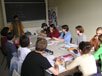 (courtesy:http://www.unil.ch/webdav/site/orient/shared/import/SpokenSanskrit)
It has a publication divison with so many learing materials in the form of books, Audio/Video cassettes, CDs and also It has a monthly magazine in Sanskrit called 'sambhashana sandesah' among these publications.
The minimum eligibility to enter in to these camps is a mere interest to learn this classical language. Without your own effort and knowledge, you are learing so many grammatical points like, nouns-pronouns-verbs-numbers-tenses etc., SB has introduced to omit the usage of dual number, second person etc. to avoid the confusion for a quick grasp of Sanskrit grammar. Hence, the learner will have a positive attitude towards the spoken activity. So he is confident enough to continue further. The wonder in the ten days camp, the medium of instruction is entirely in Sanskrit and with the help of some teaching aids the communication is more effective. Gradually, the activity of mutual introduction to form longer sentences is practiced. The central point of teaching revolves around practicing spoken Sanskrit. With the help of the teaching material you will get to know the new vocabulary. New acquisition of words and with its practice, the word and its meaning is constant in your mind. Such practice boosts the next or higher level of learning.
With such efforts and knowledge, one can able to take Sanskrit as a second language in secondary education/pre university education. All this is possible once the foundation laid is very good. The quality of education obtained and the accumulated interest till graduate level determines the further studies. Any way, if one goes for a university study or not, there is lot of scope to explore the scientific treasure of this language with a little effort further.
According the the latest census in India, of late, there more than a five lakh people who are speaking Sanskrit effortlessly and nearly four lakh people convesing the divine speech abroad. one can witness hundreds of 'samskrta grhaani' (Sanskrit homes) and a considerable number of 'samskrta graamaah' (Sanskrit villages) in the revial the classical language. As lot of research under process and studies are going on in foreign universities, we should not be hesitant to sing the glory of the divine language in this hi-tech age.
I strongly feel also effectionately, the best way to bring back the consciousness of this language is through spoken Sanskrit moment.
Tuesday, February 28, 2006
apologies
I sincerely apologize for a long sillence. Now I will have some other postings and keep this blog active with the member's contributions.
bhavadiiya,
Prasad
Monday, August 29, 2005
Pondering over the so called dead language.. (2)
- (L)istening
On a gradual manner, if one practices learning a language, gaining mastery over that is not a difficult thing. Some people say, 'grammar for any language is written after it is widely spoken among the people.' Any way, discussion on this left to one's own discretion.
A baby understands and learns the vocabulary after listening from its parents. over the course of time, it starts to speak the household language. This learning process can be extended to any age group. Because, whoever wanted to speak a language, they need to start with same process mentioned. Hence, speaking has a prominent position in a linguistic activity. It is stated that any Indian can speak atleat two Indian languages. So, let's come back to our point.
Yes! there are some possibilities or alternatives for the revival of this beautiful language. If you propagate the idea of spoken Sanskrit, then its very possible to revive its pristine glory. But you feel incomfortable after listening this? Please hold on..
Two decades back in Bangalore, an voluntary orgnisation named after 'Aksharam' was established to propagate the spoken Sanskrit activity by a group of Sanskrit scholars. They were going to house to house, village to village putting their maximum effort to realize their goal. Some other like minded organisations supported them to their daily needs.
They've targetted a village by name 'Mattur' in Karnataka, to spread the message over there. A camp for ten days organized consiting 2 prcatice hours per day. These are called 'dasa dina samskrita sambhashana sibirani.' Here, one interesting thing to observe is that the volunteers use to teach Sanskrit vocabulary through Sanskrit medium only. With the help of teaching aids, their communication is very effective. With these dedicated voluntary efforts, irrespective of age and gender, the entire village started to speak only in Sanskrit. Amazing! No one taught them The Vedas, Sanskrit grammar&literature to speak in a so-called dead language!! But it is achieved!!!
Thursday, August 25, 2005
Pondering over the so called dead language..(1)
For any language, its learning is based on its grammar and literature prevalent from the times. In olden days in India, whoever desires education right from childhood, he has to undergo a rigourous 12 years of tutelege through 'gurukula' system. By learning Vedas, Upanishads, Vedanta and Darshanas in a methodological and meticulous way, it can be assumed that one's basic study in Sanskrit is over. But the process of learning is not over! Then one can become teacher and impart knowledge to others. The colloquial language was Sanskrit even to layman, thosedays! Means everyone is capable of having atleast little knowledge in Sanskrit language. One can refer some of the Kalidasa's kavyas for an evidence to this instance.
The attitudes, behaviours and activities that are characteristic to particular social group is called 'culture.' In India, Sanskrit is inseparable from culture. It has a mass treasure of the human 'experience, knowledge and skills' through its knowledge base of 14 vidyasthanas. Hence Sanskrit and culture are equal to the context. But in the course of time, modern advancements in education prominently occupied the position in curriculum. Say, engineering or technolog and so on. In the wave of modern educational policies, the system of 'gurukul' gradually disappearing. That is a biggest threat to a language believed to be the language of gods. But how to hold on the stream of Sanskrit learning, which is the backbone of Indian culture and tradition? There is an urgent need to revive the pristine glory of mother of all Indian languages in India. Are there any possibilities?
Sanskrit literature
The holy Hindu scriptures: RgVeda
The root for Veda is “Vida (Jnane)” which means knowledge. The Vedas are four in number: RgVeda, YajurVeda, SamaVeda and Athrva Veda respectively. According to some historical resources, RgVeda is considered the oldest among these four by its language and style. Vedas are not authored; Sage Vyasa or Krishna Dwaipayana classified the Veda. Vyasa has preached RgVeda to Paila, YajurVeda to Vaisampayana, SamaVeda to Jaimini and AtharvaVeda to Sumanta who are his disciples. For the ages, Vedas are surviving and prevalent on complete oral tradition.
RgVeda is divided in two schemes. Former one is Ashtaka krama and the later one is Mandala krama. Under Ashataka krama, whole RgVeda divided in eight ashtakas. Each ashtaka will have eight adhyayas. RgVeda is comprising sixty four adhyayas. Each adhyaya is further divided in to vargas. Totally there are 2006 vargas according to Ashtaka scheme.
Under the later scheme, RgVeda is divided in to ten Mandalas. It is called ‘Dasa tayee’ also. For every mandala, it is sub divided in to Anuvakas. Each Anuvaka contains some certain number of Suktas, which contains Riks/Mantras. There are eighty Anuvakas and 1017 Suktas found in RgVeda. Each and every Rik and even the characters are also so meticulously calculated and described in a text called Sarvanukramani.
The normal recitation of Rik is called ‘Samhita patha’. The patha is fixture of metre and pattern of recitation. Eight types of Pathas or Vikritis (various combinational patterns in Vedic recitation involving accented euphonic combinations) are available for Vedas. Respectevely that are-
- Jata
- Mala
- Shikha
- Rekha
- Dhwaja
- Danda
- Ratha
- Ghana
In Pada patha every word is exploded and recited. Based on Pada patha if the order is changed and recited, it forms the different variations like Samhita, Jata etc.
According to Patanjali, RgVeda was having twenty-one Sakhas. People will have different Vedic traditions and Samskaras depending on their Sakhas.
To elaborate the Vedic idea,
Brahmanas-Aranyakas-Upanishads-Pratisakhyas-Nighantu-Nirukta
were authored. Itareya and Sankhayana are the only available two Brahmanas/Aranyakas on RgVeda. Among the commentators on Veda, Sayanacharya has written commentaries for all the four Vedas.
Eleven Suktas in RgVeda are called ‘Valakhilya Suktas’ for which Pada patha is not available.
Glossory:
adhyaya- chapter
varga-sub-chapter in ashtakaa
nuvaka-sub-chapter in mandala
sukta-group of hymns
Rik-Rgvedic hymn
mantra-hymn
sarvanukramani-a text on Rgveda by Katyayana
sakha-branch
samskaras- hindu rites of passage